The Other Is Always Out of Reach, Sometimes Even to Themselves
‘The Other Is Always Out of Reach, Sometimes Even to Themselves’ :
A Conversation on Subjecthood in BDSM
Can one voluntarily surrender power over oneself and still remain oneself? Who actually holds power in a BDSM session: the person issuing commands, or the one who submits?
Liza, organiser of the educational project Sex.Ed.UA, spoke to Dagmar, an artist and dominatrix who thinks through her practice inphilosophical terms: subjecthood, consent, transference and the field.
This conversation attempts to givelanguage to an experience more often met with silence or jokes, in terms accessible to a reader with no priorcontact with BDSM culture.
Liza: It is a pleasure to see you and to meet you. Let me begin by introducing myself and saying a little aboutwhat I do.I organise Sex.Ed.UA, an open lecture platform in Ukraine concerned with sex education, relationships andsexuality more broadly.
I see the project’s larger purpose as changing the ways people imagine relating to oneanother: what forms of contact are possible, what we may do together within them, and how we understand thisentire territory of personal and intimate encounter. We have also held many lectures on BDSM and fetishes, and discussed the roles people inhabit within thesepractices. That is why I invited you today: very few people are willing to discuss this subject in philosophicalterms, through categories of subject and object. So I would like to ask you to tell us a little about yourself: what you do, where you come from and how youarrived at BDSM practice.
Dagmar: Tell me, how should I address you: Alisa or Liza?
Liza: Either Liza or Alisa is fine.
Dagmar: It is a pleasure. I am Dagmar. Broadly speaking, I describe my work as a multidisciplinary1 artisticpractice, and I think of myself first and foremost as an artist. Alongside that, I have several business strands that Ihave been developing for quite a long time, both through my brands and in relation to my artistic work. Since 2016, I have worked on Nomad Goba, a project in avant-garde menswear and perfumery. More recently,after the outbreak of the war, we created a new project, Odiosa. I left my previous project and began again. So there is a commercial branch, still closely connected to art but more explicitly structured as a business. Eventhere, however, there is a great deal of craft, handwork and collective involvement.
My own practice, though, is art. I work primarily in analogue fields2: fine-art drawing and printmaking3, painting, vocal and instrumental improvisation; I compose music. I move across many areas, and the practicegrows out of research into ritual.
Since childhood, I have studied various forms of psychosexual pathology and forensic science; that is simplyhow my biography unfolded. I also work with performance, theatre and perfumery. Analogue media4: I reach foreverything I can. I am from St Petersburg, Russia.
1 Multidisciplinary artist — an artist working across several art forms and media.
2 Analogue fields — material and embodied areas of artistic practice involving physical media, the body, voice, spaceand sensory experience, rather than primarily digital forms.
3 Fine-art drawing and printmaking — autonomous works on paper and in print, including drawing, engraving,etching and lithography, rather than illustration or applied design.
4 Analogue media — physical means of artistic expression such as paint, paper, the body, voice, sound, scent, objectsand space.
1 If we are talking about the origins of my BDSM practice, directing was the first medium and the one closest tome. From about the age of four, as far back as I can remember, I staged performances. That was my earliest formof making: directing a shared field, a practice that was directive as well, involving different kinds of bodilyexploration and mutual inquiry within that field.This is difficult territory to speak about, because we are talking about children, childhood perception and thechild’s psyche. Can I call interactions and games with other children any particular kind of practice? Probably not.
But my sense of the field5 had already begun to form in childhood. In truth, I find it difficult to identify a singlepoint of origin: where, or at what moment, it began.I can say that directing came ‘before’, perhaps as a precursor, but these categories are difficult to delimit.
Liza: Am I right in understanding that you perceive the space of a BDSM session as a kind of theatre?
Dagmar: No, not at all. By directing I mean something closer to the architecture of a shared space, of a sharedinteraction. That architecture may appear in many domains, including theatre.
Theatre is a useful form for describing the mechanics of many phenomena, ritual phenomena among them, and inthat sense it is broad. But it is not broad enough to describe a BDSM session. I may need your help to narrow thediscourse, because my thinking is markedly split6 : I inhabit several domains at once. ‘Theatre’ cannot containwhat happens for me, specifically, within a session. My method within BDSM, and my method as a professional practitioner, a dominatrix, although I still identifyand describe myself primarily as an artist, is an artistic method. That distinction is very fine, but it matters. The method is, of course, still taking shape. I am at a point where I can try to give language to many things, yetmy experience of domination remains the least available to language. It is still under investigation; it remainsextraordinarily difficult territory, not least because of the ethical questions involved7. So yes: theatre is far too narrow a measure for a session. We can go further into it, but I will need your help tokeep the movement precise.
Liza: Then let me phrase it differently. How do you see your own place within a BDSM session? How do youdefine and formulate it from the position of experience and understanding you have reached at this point?
Dagmar: My place in the session… It is a kind of post-consensual directive presence8. First and foremost, my place in the session is the session itself. I can describe what I do, but the word ‘session’ does not quite carry the depth of the space we mean by it. A session is not simply entered; it is created.I do not enter by ‘renting’9 a pre-existing session space. In a sense, I am both the session and its frame. I shape the architecture of its time, its space and the purpose of what is taking place.
5 The field — Dagmar’s term for the emergent space of interaction comprising the participants, their bodies and roles, the rules, actions, setting and relations between them.
6 Split — here, a mode of thinking that does not proceed along a single linear path but occupies several domains orconceptual directions at once.
7 The ethical questions include the limits of permissible influence on another person’s psyche, the dominatrix’s responsibility, and the use of access granted through consent.
8 Post-consensual directive presence — Dagmar’s own term for a mode of domination in which, after a consensualframe has been established, the dominatrix assumes an active and directive position within it. It is not a standardBDSM term.
9 ‘Renting’ the session — a metaphor for entering a ready-made structure. Dagmar contrasts this with a session that iscreated through the interaction and of which she is herself a constitutive part.
2 Again, post-consensually. So I am more inclined to answer: ‘What do I do?’ What do I do for a session to come into being with me as thedominatrix? How do I construct it? But your question opens an enormous subject in itself. It takes me a long time to articulate many things in thisparticular territory, because they are difficult. We are speaking about psychic life, about another person’s psyche. In very simple terms, I could say that my place in a session is that of the director, or rather the architect: thearchitect of a psychic space10.
Then the conductor, the maker of circumstances, the researcher. Above all, perhaps, the researcher. Yet it is easier for me to answer what I do.I think the session itself is my place. (Laughs.) Sometimes, provided it is consensual11…
But consent is precisely where I began. What I am describing is, infact, a post-consensual phenomenon.
Every session permits an enormous diversity12 of forms, because my place is defined through agreement with aparticular person. The amount of space in that person’s psyche, the other who enters into consent with me, and the amount ofmaterial to which they grant me access in advance determine my place in the session.
So it is profoundly shaped by the terms of consent13.
Liza: Is there a difference between you inside a session and outside it? You said that you do not separate your artistic identity from the way you shape space within BDSM. We candevelop that thought if you would like. Otherwise, I can move on to the dynamics of power and to the moment atwhich power is handed over within a BDSM session. I would also like you to speak in detail about whether a submissive loses their subjecthood within a session, andwho actually holds power in that space. Is it the dominatrix or the submissive?
Dagmar: Let me return briefly to your previous question. How exactly did you put it? What is different fromwho I am in a session?
Liza: Yes. Most people I know who practise BDSM as dominants or submissives separate their social lives fromwhat they do as BDSM practitioners. That produces a tension between one’s social role and one’s role within the session. Do you experience such adivision? Is it only within the BDSM space of the session that you put on a particular role? And when that space closes, is there another artist, another woman, who can expand her consciousness, herbodily experience and her psyche to the dimensions of the session, or contract them again?
10 Architect of a psychic space — a metaphor for shaping the structure and conditions of an interaction withoutclaiming complete control over the other participant’s inner experience.
11 ‘Consensual’ is used here not merely to describe individual acts but to indicate that consent establishes the framewithin which the session becomes possible.
12 Diversity — the range of possible forms, scenarios and modes of interaction.
13 The character and extent of the dominatrix’s actions are shaped by the access and forms of interaction agreed inadvance.

3 Dagmar: What may matter here is how coherent14 I experience myself and my inner space as being.Is it coherent? In a sense, the question does not arise for me in the first place. My psyche has a certain tendency towards splitting: something like a pronounced multiple-personalitystructure15, and a dissociative split16 that has been present since childhood.At the same time, I have a very strong capacity for self-reflection17 and for taking a meta-position18. I have beenfortunate in that. The constitution of my psyche19 and the conditions in which I developed have shaped me so that the question ‘Is this still the same person?’, when asked within the ego-structure20 of my own inner perspective, makes me smilerather kindly.
At the level of ego-structures, I am not a homogeneous person. Everything to do with functioning and reaction, representation, the dissociative musculature one develops21, distinct personalities and formations of personality: that is an enormous layer.
Yet throughout all these states, in my particular case, I very clearly sense the presence of a relatively coherentpart that observes. So my mode of presence is ambivalent22: I am inside the state and observing it at once. Am I performing a role?
It seems to me that I perform, in some sense, at every moment, within every changing scene, circumstance andencounter. It does not matter what the medium is, or which person or phenomenon I am meeting.
Something changes at the level of ego-structure, at the level of persona. Does that alter my access to sensation, to the fullness of sensation, or to some additional, more expansive form of presence within the process?
No. I would not say that the degree of my presence changes substantially from one social circumstance toanother.At the same time, every interaction, whether or not it is a session, produces some change in me.It makes no difference whether a poppy field or a submissive offers me its material for interaction.Consent is the difference.
14 Coherence — the felt continuity, relative stability and inner connectedness of one’s sense of self.
15 ‘Multiple-personality structure’ preserves Dagmar’s informal self-description. It should not be read as a clinicaldiagnosis; ‘multiple personality disorder’ is an obsolete diagnostic term, now replaced by dissociative identity disorderin current classifications.
16 Dissociative split — a self-described tendency towards separation between states, parts of experience or modes ofself-presentation. The phrase is used descriptively rather than diagnostically.
17 Self-reflection — the capacity to observe and interpret one’s own states, reactions and actions.
18 Meta-position — an observing standpoint taken in relation to one’s own thoughts, feelings and states.
19 Constitution of the psyche — the overall organisation and characteristic functioning of the psyche, shaped byindividual disposition and developmental conditions.
20 Ego-structures — ways in which identity, continuity and the sense of ‘I’ are organised.
21 Dissociative ‘musculature’ — Dagmar’s metaphor for developed capacities to separate, shift between or maintaindistance from different psychic states.
22 Ambivalent presence — simultaneous immersion in a state and preservation of enough distance to observe andreflect upon it.
4 A poppy field cannot tell me that it would prefer not to be admired, run through or stripped of its flowers. I maydo those things and then question myself about them.There is a little more freedom in that interaction, but also more that remains displaced or repressed23. When I encounter another person’s psyche, I can choose what form the interaction will take. There is, unquestionably, work with archetypes. For example, if this were happening now…That is why I asked why you wanted to speak specifically with me. If what interests you is the movement of mythought, and the way I make sense of my practice, that is one territory.
Another territory would be consultation, or practice approached as a method and a professional field.If we were speaking now in a professional consultation, dominatrix to dominatrix, we would be talking aboutarchetypes24: not about ‘playing’ them, but about how particular forms bring us into contact with anotherperson’s psyche, and how to recognise those forms.
And even then, I would begin with the dominatrix’s safety.
When a dominant relies on the idea of role-play, the territory becomes very dangerous.
When one works with the psyche, and this is why it is not theatre and cannot become theatre, transference withina session is real25. The additional frame of a scene or an artwork, even the containing frame of a protocol26, is not enough to protectthe dominatrix’s psyche from genuinely inhabiting those parts of herself that resonate with repressed processes inthe submissive’s psyche.
If we were speaking in strictly professional terms, I would begin by defining this territory much more concretely.I would advise a practitioner to choose a form in advance and describe it in detail before allowing it to appear ina session.
My own interest, however, lies in sensation and in the newness of reality.
That places me in a grey area27. I accept a degree of risk in order to inhabit real states of my own, stimulated bythe access and the psychic places opened to me by the person with whom I am working.
Liza: I think this is a good point at which to return to power within the session. Who possesses power in a BDSM session: the submissive or the dominatrix? Does the submissive genuinely losetheir subjecthood? Can submissiveness itself be an act of will?
23 Repression is used here in a broad psychodynamic sense for experience excluded from conscious awareness. Thecomparison with a poppy field is metaphorical and does not attribute a human psyche to nature.
24 Archetype — a recurrent psychic or cultural form through which experience and relations may be organised. Dagmar uses the term broadly, rather than as a strictly technical Jungian category.
25 Transference is used here broadly for the activation and displacement of earlier relations, expectations and psychicimages within the session, not exclusively in its technical psychoanalytic sense.
26 Containment — the capacity of a frame to hold and organise intense experience. Dagmar’s point is that namingsomething a scene, artwork or protocol does not by itself protect either participant from real psychic consequences.
27 The grey area lies between professional responsibility for the submissive’s safety and autonomy, and Dagmar’s useof the session to investigate her own lived states.
5 Dagmar: I think this may be the most difficult question in the whole practice. It sits at an intersection28 ofbiology, sociology and politics, and therefore touches conflicts that are acutely present for us.It is also a question of definitions.In professional BDSM, when we speak of a session, we begin with consent and protocol. Consent presupposes subjects29 within the dynamic who are capable of agreeing to the process as it unfolds.
Yet I often speak about submissiveness, as a way of being and as an act, having, at many points in a dynamic, fargreater gravity30 in shaping the interaction than the dominant’s acts or directives.
Very often, it is the empty spaces that determine what will fill them.But that is only one part of the process.
Who, then, possesses power?
Does power exist as a construction, almost as a physical phenomenon, as theprimary object of exchange, as a mechanism? I think it is real enough.
The ownership of power is an extraordinarily difficult question. I cannot quite answer it, but I can explain how Ilive with its difficulty. For me, it raises the question of human nature and of will31: whether will exists at all. From there we enter the vast territory of neurobiology32. Human beings are remarkably easy to dehumanise33; generations of war, mass psychosis and much else make that plain.
At present, I do not think we can simplyclaim that the human being possesses an autonomous will.
In my own view, will is an almost terribly inhuman property.Yet in the register in which we say ‘I went’, ‘I wanted’, ‘I said’…there is unquestionably some point from which observation occurs. What helps me think about this is the constitution of my own psyche: a certain split, the presence of intrapsychicconflict, the constant need to sober my own inhabiting of myself. All of that teaches me something aboutproducing particular effects34 within a session.
What happens is this. I have the sense that the dominatrix, specifically, has real access to altering the coherence of another person’s subjecthood35.
28 Intersection — a point at which several domains meet.
29 Here a subject is someone capable of decision, refusal and consent. Consent therefore presupposes participants whopossess some degree of agency and autonomy.
30 Gravity — Dagmar’s metaphor for the psychological weight or force exerted by a desire, absence, deficit, intentionor action.
31 Will — the capacity to make conscious decisions and initiate action. Dagmar is invoking the philosophical andscientific dispute concerning the existence and autonomy of free will.
32 Contemporary neuroscience and philosophy of mind debate how conscious intention relates to the brain’spreparation for action. Dagmar invokes that debate rather than asserting a single settled neuroscientific theory.
33 Dehumanisation — the process of treating a person as less than fully human, or as lacking dignity, autonomy orsubjecthood.
34 ‘Effects’ refers here to psychic and bodily states that may arise during a session.35 The coherence of subjecthood — the extent to which a person experiences themselves as a continuous, stable andautonomous subject of their own actions and experience.
6The human psyche readily incorporates definitions of itself into its own structure.When another person’s psyche encounters a definition of itself, whether it rejects or accepts it, it must first livethrough that definition as a possibility: as though, for an instant, this may be what is true.In ordinary life, if you tell someone that they are bad, their first response is to undergo the proposition; onlyafterwards do they agree or disagree.
In that sense, every description is invasive36 by nature.
This is a profoundly unqualified opinion, because I am neither a psychotherapist nor a psychoanalyst; Iinvestigate the world empirically. But I believe the other is unreachable. For me, that is an axiom.
Another person’s psyche cannot think what it cannot think. Yet one must never build professional practice on that proposition37. Professional practice begins with safety. We must therefore acknowledge that an actor38 who enters the field with a directive39, and is granted the right todefine the other, acquires a certain power over the coherence of that other.To me, that is absurd.And yet, damn it, it appears to be true. The entire twentieth century shows that when a person is told what is good and what is bad, their relation to theirown otherness can change.But the more interesting question is what exerts the greater gravitational force.
Why can a directive from the dominatrix during, for example, humiliation intensify the submissive’s experienceof their own subjecthood and sovereignty?
Because the gravity of emptiness and of deficit40 within the submissive at that moment, together with their ownhistory, may carry incomparably more weight than anything the dominatrix says.
This brings us into a territory that, for me, sounds like: ‘An experience I consciously choose.’ I wanted to go; I bought the plane ticket; I flew. So who did it: the others, or me? If I enter an experience in which someone calls me a fool, having consented to precisely that, and somethingoccurs in me, then perhaps that experience becomes a means of affirming the structures of my own self.
36 Invasive — entering or crossing a boundary. A description acts upon the person described, even when they rejectit, because they must first encounter and process the proposition.
37 Dagmar explicitly distinguishes an empirical or philosophical hypothesis from a safe professional method. Apractitioner’s belief that they understand another person’s psyche must never override consent, safewords, observablechanges of state or the participant’s own account of their experience.
38 Actor — a participant who enters the field with the capacity to act and issue directives.
39 Directive — an instruction or command that shapes not only behaviour but also how a participant is positionedwithin the interaction.
40 Deficit — an absence, unmet need or psychic lack already present in the submissive and capable of exerting itsown force within the session.
7 In my work, for example, practices of extreme depersonalisation41 can become among the most extraordinary andparadoxical territories for triggering a submissive’s authenticity42, their selfhood, their real presence in the space. When I create circumstances in which they gain access to absence, they emerge from it as themselves.
But how do I know? Because they tell me. And then the question is… (Laughs.)
Is that what they truly think, or did I implant the idea through my own desire at the beginning of the practice?
This gravity is fascinating because emptiness may exert more force than action.
But then I must turn back towards myself and ask: ‘What am I doing there? What interests me? Amongeverything I experience, do and feel in the moment, the voids, deficits, assets and liabilities, what within meexerts the greatest gravity?’
It seems that my gravity is concentrated in the intention to see the other. My primary motive is to witness an unfolding43. I want to see that the other is truly other, and to see how astonishing that otherness is.
One could say that this makes my practice pretentious and even slightly totalitarian44.I am claiming that, through my desire to see the other, while altering anything I choose within the process, I canshape a field in which they begin genuinely to experience their otherness and their subjecthood.
So my starting percept45 is this: the other is always out of reach. Sometimes the other is out of reach even to themselves.
And here we enter the territory of psychosis46.
Liza: I would like to return to consent. Is consent the beginning of subjecthood, or a limitation upon it? Whatdoes consent mean to you? Can a person genuinely and voluntarily agree in advance to relinquish power and theability to make decisions during the process? Suppose a submissive says at the beginning of a session: ‘I give you all the power. Make the decisions yourself. ’Is that a limitation of subjecthood, or its beginning?
Dagmar: Perhaps, if subjecthood is beyond dispute, every experience necessarily touches it.
41 Depersonalisation — an experience of estrangement from one’s self, body or mental processes. Dagmar uses theword for an intentionally induced BDSM state; this should not be confused with a claim that such an experience isuniversally therapeutic or safe.
42 Authenticity — the experience of being in correspondence with oneself.
43 To witness an unfolding is not simply to observe but to be present as something previously hidden becomesperceptible. The paradox is that Dagmar is both witness to and co-author of the conditions in which that unfoldingoccurs.
44 ‘Totalitarian’ is used self-critically and metaphorically. Dagmar is identifying the danger in claiming to revealanother person’s ‘true’ self while simultaneously shaping the conditions under which that self appears.
45 Percept — the other as apprehended within one’s own perception.
46 Psychosis is used here philosophically or metaphorically, not as a clinical diagnosis: it names the rupture betweenlived reality, self-knowledge and the interpretations through which a person becomes intelligible to themselves andothers.
8 I have a sense that subjecthood is an option available within being. It is a kind of place, a concept, and one has todiscover where it is situated for oneself. This is closer to agency47.Consent belongs more directly to agency. The act of consenting is, in itself, too slight to manifest or trigger subjecthood. The categories are not entirelycommensurable.But it can trigger and restore agency48.
Yes.‘I read.’‘I consent.’‘I act.’ Those are useful beginnings: acts through which subjecthood may be manifested and addressed.
But the relation is not linear. We still live in a capitalist, patriarchal world49, amid many combinations of power and many readily digestibleconcepts offered by consumer culture, any of which may divert us from that path.
Power and money are explosive subjects. Money on the path to power, and the way it functions there…(Mysteriously.)
Our operating system may not survive it.
Consent can therefore appear to be merely another act of control, including on the submissive’s part. Yet if control is exercised through agency, it may also become a means of moving away from subjecthood.
My thought, and my lived experience, is that any act whatsoever may manifest subjecthood, and any act mayalso become an escape from it.
What matters here is that subjecthood itself, in my view, cannot be delegated. Agency can. Consent, however indispensable it is in professional practice and in any human communication, unfortunately orfortunately does not have the profound access to subjecthood, to its construction or to the experience of it, thatwe, or that I, might wish it had.
Because people… Again, this comes from experience. Professionally speaking, I have encountered consent in many different forms. Some people bring detailed lists. Yet even after an explicit act of consent and after following an agreed protocol,they may encounter inner conflict or repression. As I follow the protocol they established, I may still meet their collapses and drops50 precisely in the zones theythemselves identified.
47 Agency — the capacity to initiate action, choose, refuse, make decisions and experience oneself as acting.
48 Dagmar distinguishes agency from subjecthood. Consent may affirm ‘I act’ and thereby restore agency, but it doesnot by itself establish the deeper experience of oneself as a subject.
49 Consent and power do not operate in a vacuum: economic dependence, social position, gendered expectations andother structural pressures may constrain what appears to be a voluntary choice.
50 Drop — an emotional or physical downturn that may follow an intense BDSM session or altered state.
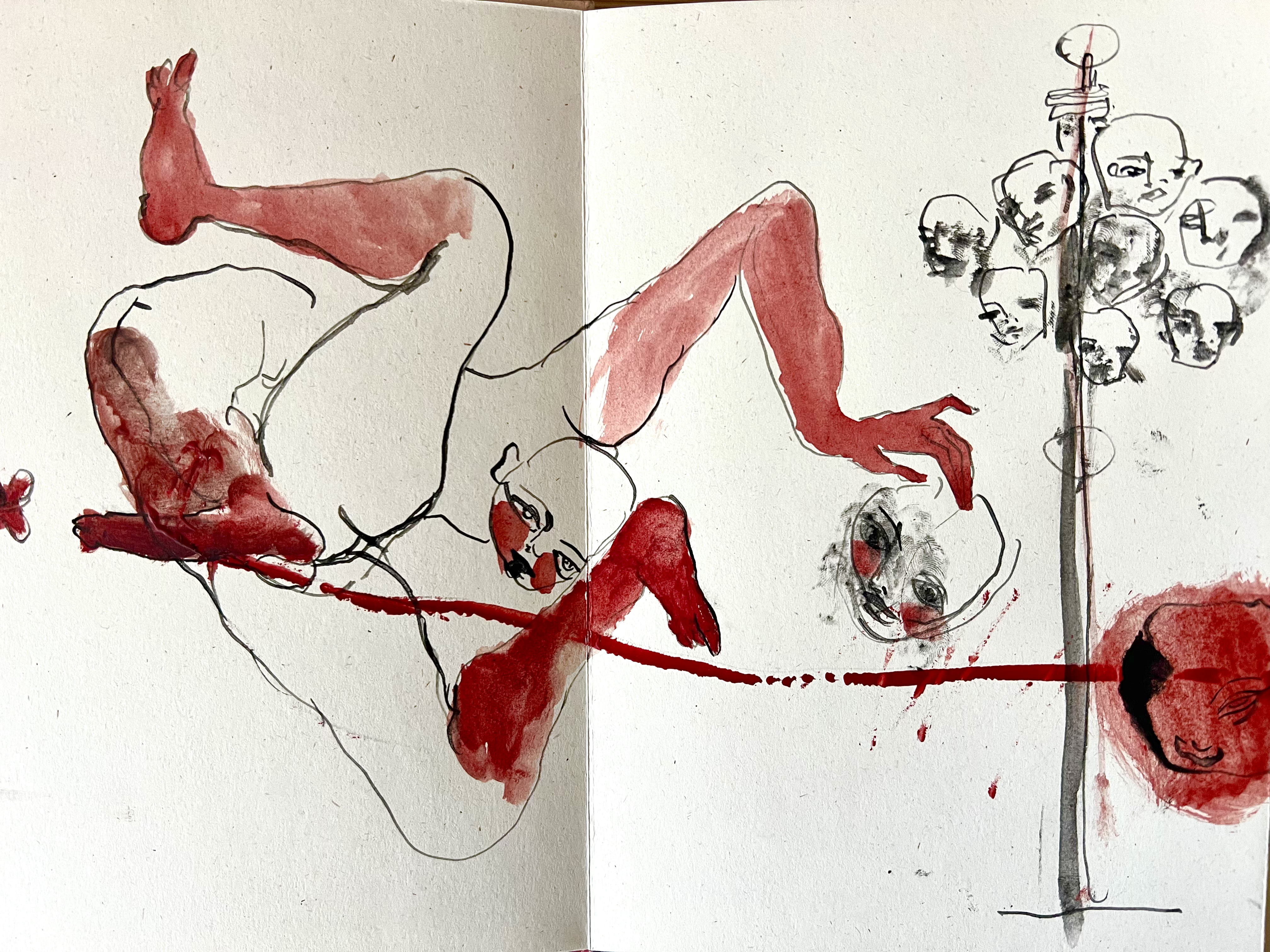
9 And they may still transfer responsibility for those drops to me. The reverse also occurs: within the protocol I literally formalise my own refusal to be fully protocolled, and stateexplicitly that the person’s list will not govern the route of the session51.
Consent comes first; then the protocol.
A person gives me a list of what feels good and what feels bad, and in my protocol I write: ‘But that list will notdetermine what I do.’
The person says, ‘Yes.’
And we enter that space. I take an unpredictable route, and afterwards the person says: ‘God, I am myself. This is what it feels like to be me. Wonderful.’
From my practice, I can say that subjecthood does not begin and does not end.It simply is. The question is whether the psyche, the soul, I do not know what word to use, rides that horse.
Liza: Does submissiveness arise in relation to a particular person, or does it exist in itself? Can submissivenessexist without domination? And what part do voice, archetypes and protocol play in allowing that experience todevelop?
Dagmar: The answer should already have begun to form where I was speaking about power and to whom itbelongs. Even asking how submissiveness forms in the presence of a dominant, or of dominant circumstances, is alsoasking how the dominant is formed in the presence of a submissive.
And my answer is that power belongs to the field52.
Liza: I have a question written down about power not belonging to one person but arising between people. Youhave just begun to answer it…
Dagmar: I think we will open it out a little later. We cannot avoid it, because we have already touched oninteraction, and interaction is the most important thing taking place.
Everything that happens, happens in interaction.
A multitude of elements participates in that interaction: everything present that can be detected53 by thoseinvolved. The setting54, the architecture55, the environment56: everything available to the person’s senses.
Nothing in that situation is stronger than the field.51
This passage describes advance consent to unpredictability within a negotiated frame. It should not be read asconsent to ignore hard limits, withdrawal of consent, safewords or changes in capacity during the session.
52 The field — the emergent relational force produced by all the participants and conditions of the interaction, whichthen influences what occurs.
53 Detected — perceived, registered or picked up by the participants.
54 Setting — the material, social and temporal conditions in which the interaction takes place.
55 Architecture — the organisation of physical, social, psychic and symbolic relations within the interaction.
56 Environment — the surrounding material and sensory milieu.
10 I do not yet feel able to develop the definition much further.
Yet it is the first thing I discuss in any consultation, because it concerns what I do within every session.
If someone comes to me for a thirty-minute consultation, if there is no shared setting, and I can give them onlyone piece of information before we may never meet again, this is what I tell them.It concerns safety: the timely acknowledgement of, and delegation to, third forces57.
The third force is what emerges from the totality of all the factors in play. And the sooner one recognises it…This is especially important for a dominant. At an early stage of learning to understand power, experiencing asubmissive’s transference can be intoxicating. The hormonal chemistry can delay comprehension58. Adrenaline and endorphins59 can make you lose yourself: you climb into the archetype’s car and accelerate.
That can produce an effect. It can also drive you into a wall at the precise moment when you need to take flight.
What I always say is that once a particular combination and chemistry arise, when a proverbial tic in one persontriggers something in the other, that combination will exert its own logic.
The individual being produced by all the factors present60 is more powerful than all of us within the field takentogether.
To me, that is self-evident.We can see the influence of everyone present, everyone observing, but…This is part of what drives me to assemble settings.
Since I was four, I have been drawn, through directing, toassemble architectures of people and combinations of psyches.Directing interested me because I watched and felt people, and saw how differently they opened in differentcombinations.
It is almost obvious: some people’s areas of deficit fit together, while others do not. I often hear experiencedprofessional dominants say: ‘A submissive reveals a dominant in their full strength. You have to meet the two or threesubmissives who are truly yours, the ones who reveal you.’
I partly agree, and I think the reverse is equally true.
More than that, I do not believe there are one-way processesin the psyche61.
57 ‘Third forces’ are the emergent effects of setting, atmosphere, bodily state, transference and context. Dagmar argues that safety requires recognising that the session is not produced by the conscious wills of two individuals alone.
58 Intense arousal and bodily activation may temporarily impair reflection and delay recognition of what is occurring.
59 Adrenaline mobilises the body under arousal and stress; endorphins can reduce pain and contribute to pleasure oreuphoria. Dagmar uses them as shorthand for the neurophysiological intensity of a session, not as a complete scientificaccount.
60 Dagmar describes an emergent dynamic that does not belong to any participant separately and may become morepowerful than their individual intentions.
61 The influence is reciprocal rather than one-way: the dominant shapes the submissive, while the submissive and thedeveloping field simultaneously shape the dominant.
11 Non-linearity and non-duality coexist with linearity and duality.
I am somewhat committed to an inclusive logic62. If power is surrendered on one side, it is taken up on the other.
Someone who is submissive in one situation may be dominant in another. This is not simply a matter of socialroles; it concerns the system’s capacity and desire to regulate itself. I have the sense that it is almost impossibleto know the dominant position without having experienced submissive space and found that space within oneself.
To experience submissive space, one must find a structure in which that submissiveness can emerge. This is whatI tell people in consultations: ‘Find the circumstances in which you bow as the submissive who comes to you bows before you.’ So that you can think the experience through63 and carry it elsewhere; so that your directives64 become moreethically attuned, more interesting, deeper, further-reaching, more expansive and more joyful.
This is a difficult point. People who find room in their lives and in their way of being for both positions, who canopen both sides, seem to me more inwardly fulfilled65.They have greater access to their own inner structures, and greater access to pleasure.
Liza: How does your sense of your own body change during a session? And how does your perception of theother person’s body change? The body is, after all, a limiting factor, but our experience of embodiment varieswith context and circumstance. So how does your perception of your own body change when you aredominating?
Dagmar: Sessions vary enormously. What unites my experience is that, when I enter a session, I maintain closeattention to my own bodily sensations and to those of the submissive.
I carry a high level of responsibility there.
I approach the threshold of a session with that responsibility. Within it, the body is my primary compass foraction. My body is highly reactive66. I respond quickly and track those responses. More than that, in a good session,transference operates strongly for me. I work closely with incorporation67, specifically with controlled incorporation.
One area I investigate is making my own highly sensitive sensorium available to the attention of a submissivewhose access to sensation may be impaired in particular places.
62 Inclusive logic — an orientation that permits apparently opposed forms, such as linearity and non-linearity ordominance and submission, to coexist rather than treating them as mutually exclusive.
63 Here ‘thinking the experience through’ conveys the source word’s sense of mentally exploring, transposing andtesting an experience in another position.
64 Directive — an instruction or command given by the dominant to the submissive.
65 Inwardly fulfilled — content in the sense of having fuller access to one’s inner organisation and sources ofpleasure.
66 Reactive — quick and sensitive in bodily response. Dagmar presents this reactivity as a source of informationrather than as loss of control.
67 Incorporation — Dagmar’s term for bringing another person’s sensory or affective state into one’s own field ofbodily perception through attention and attunement.
12 I am good at practices of incorporating attention68: bringing the focus of what they feel into my own sensory experience.
It works in both directions. Transference cannot be made one-way. If my attention is concentrated on thesubmissive’s body, the process also acts back upon me.
The further I enter the session, the deeper the immersion.
Passing through what I call the adrenaline window69 produces one kind of bodily state: a form of anaesthesiagenerated by different affects.
Shame, pain and arousal are all anaesthetics of a kind.
As affective states70 within the session, they can partiallyobstruct access to the body in its fullness. I therefore try to regulate the rhythm with which we enter affect, so that I can return sensory access to myself andto the submissive.
For me, then, it is a regulated process. In bodily terms, the session is not larger than I am. I can direct it as I direct attention, because I remain in contactwith myself and with my sensations.It is also a territory of experiment.
If I can partly direct the process and choose the intervals in which we ‘ground’71 and recover sensory contact, then I may choose not to draw a submissive who has entered a powerful subspace back into the body immediately.
At the same time, I know that if I fully recover my own sensory contact72, the submissive, oriented towards meby the directive given at the beginning of the session, may return with me.If I enter domspace73, that too is an ethical grey area, because it is a kind of high74. We become somewhat high; I allow an endorphin window75, and we ride an enormous wave.In a very elevated state, I can assign responsibility for my grounding to myself, and for the submissive’sgrounding to them.
At times I can allow sensory awareness to recede, provided that I have established anchors in advance. We might agree beforehand that after four hours we will do certain specific things. I also try to draw myself outof the endorphin window in time, so that the process does not collapse.
So yes: I feel my body clearly and orient myself through it.
68 Incorporating attention — deliberately holding another person’s sensory focus within one’s own bodilyawareness. The term is authorial rather than a standard clinical category.
69 Adrenaline window — Dagmar’s term for a period of intense physiological activation during a session.
70 Affect — an intense emotional and bodily state that alters perception, thought and sensation.
71 Grounding — returning to fuller contact with the body, immediate surroundings and sensory perception after anintense or altered state.
72 Sensory contact — access to information arising through the senses and bodily feeling.
73 Domspace — a term used in BDSM communities for an altered or highly concentrated state experienced by adominant, often involving flow, heightened focus and altered perception of time.
74 High — here, a state of elevation, euphoria and altered perception produced by the intensity of the session.
75 Endorphin window — Dagmar’s term for a period of elevated or altered experience in which pain and otherbodily signals may be attenuated.
13 I allow the anaesthesia of elevated states to remain for longer.If the anaesthesia belongs to a drop, however, that is an unequivocal signal to return urgently through the senses,and only then move towards elevation again. So it is a regulated process.
Liza: What you describe resembles an emotional swing, or a rollercoaster.I would like to ask one final question. If you could dismantle a single myth about BDSM in popular culture,which myth would it be?
Dagmar: I have thought about it, and I would not dismantle a single one.I would create still more myths around BDSM. It is a difficult territory to reach, and the myths mean that veryfew people arrive at the reality of the practice. Every myth surrounding BDSM contributes, in its way, to thequality of my communication with my submissives.
The people who reach me are exceptionally rare: people whohave completed a real journey. The more myths there are, the more demanding the path towards genuinecommunication becomes. Those who have made that journey, who have written and asked, are people whose communication I value fromthe outset. Given that I am a very generous76, giving and rather naive person, and that I invest heavily in others,the absence of that filter would be a serious problem for me.I feel quite well protected by those myths. The actual experience of engaging with a dominatrix or a dominant,when every practice is radically singular, is a kind of magic to me: a miracle, something exceedingly precious.Those who practise it perform extraordinarily difficult emotional labour. Even stigma, in some respects, guardsthe temple of this art. And I regard it first and foremost as an art.I understand that this produces many problems. We live in 2026; there are more than enough problems.
Perhaps this is the cognitive bias of someone passing through considerable difficulty and partly romanticising it.Even so, these myths seem to me a natural preservative, a biome that allows the craft and the profession tosurvive at all.
Liza: Thank you.
My observation is that not everyone who practises BDSM has this depth of perception, or an intellectual foundation sufficiently developed to think about it philosophically and intersubjectively, and to speak in these categories.Thank you.
Would you like to offer a few closing words?
Dagmar: Thank you very much.I have taken time to look at your path and the materials you have made available, and I find the work deeplyworthy. It is a genuine pleasure to have a space in which I can share this honest territory of reflection. It is a kindof meta-level, with greater access to honest material than one often finds in professional conversations. Professional conversations are oriented towards practice, which is entirely understandable, but there is very littleof me in them. To be able to speak from this other place is precious. Many things are difficult to articulate. Onefrequent consequence of entering territories like these is social solitude: not necessarily because of stigma, butbecause of the complexity of one’s biographical pattern and of the experience itself. The further one goes, theharder it becomes to create, between two or more people, a space and field in which what is happening can belaid out calmly, exactly as it is.
76 Generous — open-handed, giving and inclined to invest heavily in others.
14 And that is magical.
Thank you.
In Place of an Afterword
My experience suggests that BDSM has something in common with mystical practice.
Someone who has entered an altered state of consciousness through religious ritual will often also struggle toexplain what, precisely, happened to them.I think people who undertake practices that produce altered states of consciousness encounter the same difficulty.
I would include domspace, subspace and other states that may arise within a session among such altered states.Because we are social and structure-seeking beings, deeply attached to categories and concepts, it isextraordinarily difficult to convey such an experience to someone who has never undergone it and has noequivalent within their own empirical experience.Through my media projects, I am trying to bridge that gap: to give such experience a language and a conceptualform through which it may become intelligible to a lay reader, to someone for whom it is entirely unfamiliar andwho stands far from these subjects and states.I hope I succeed.
Compiled, edited and prepared by @Khitrova_2.0 · @sex.ed.ua2026